Process

Dinosaur, by Iván Argote – New York, NY
Maybe it’s something about autumn that leads me to flights of rhetorical fancy. It is, after all, my spiritual springtime. Even as a child in Florida, the first chilled breezes free of humidity awakened something, like a breath sweeping in from the horizon, ushering in the promise of change. I mention this because in preparing this post I at one point sought out one from the past. Sure enough I found it, planted in November 2021. Drawing from a similar vein, today’s post isn’t so much about craft as it is inspiration, possibly even hope. Because heaven knows we need that now. This is my gentle nudge to look beyond the uncertainty hanging over us, and to instead focus on our purpose.
My message is simple, a phrase we’ve heard our whole lives but discount far too often – Keep your eye on the prize.
So, let’s get to it, shall we?
Wild Cards and Wise Words
This summer I stumbled upon a wonderful new podcast. NPR describes Wild Card as “part-interview, part-existential game show.” I call it fascinating. Rachel Martin is a talented host with a gift for conversational exploration. And the team behind the show has done an amazing job finding individuals from a variety of creative backgrounds to delve into topics that strike resonating chords in a fresh, inviting way.
The concept is intriguing. Martin engages guests via a series of card options, each with open-ended questions intended to spur discussion on, well, whatever comes to mind. The questions themselves touch upon memory, belief, life lessons. Past questions have included the following:
Last week’s guest was Erykah Badu, a singer songwriter some call “the Queen of Neo-soul.” Badu’s music combines elements of jazz, soul and pop, delivered with a voice reminiscent of Billie Holiday (though she is quick to point out that many artists influence her). Embarrassingly, until the podcast I had never heard of Badu. But her response to one question made me take instant notice. Badu was asked, “Is there anything you long for?”
This was her response: “Yes. I want to get my best work out of me, because it’s still in me. And I feel it. And something in me can’t let it go yet. I long for that moment that I’m able to let that go and give it to the world.”
Wow! Talk about cutting to the chase. I had my own driveway moment evaluating my own life choices. And you know what? It felt wonderful. Because for the first time in weeks, I was swimming in my world instead of tussling against currents beyond my control. That realization was my spark for today.
How does one get back to what truly matters? How do we rediscover the things we love and the things that motivate us, both creatively and personally?
Make an Honest Assessment
One lesson from my life, which I have to relearn on occasion (and my answer to another Wild Card […]
Read More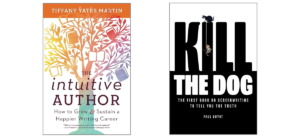
As a connoisseur of writing how-tos (and yes, I had to look up how to spell connoisseur – and okay, “addict” might be a more accurate word), I have read a TON of them. And while I find valuable nuggets in nearly all of these books, lately I’ve noticed that many recent writing how-tos are essentially sharing slightly different flavors of some very similar core information.
So when I encounter a book about writing that offers some new (to me, at least) ways of looking at the craft, I sit up and take notice. My gushing ode to Chuck Palahniuk’s Consider This in this 2020 post is an example.
I just finished reading another such departure from mainstream writing how-tos: The Intuitive Author, by WU’s own Tiffany Yates Martin, who, in addition to being a wonderful writer and editor, is also an insanely good teacher and public speaker. Seriously, if you ever have the opportunity to attend one of Tiffany’s sessions or events, take it. And if you’re an author who speaks at literary conferences, trust me: you do NOT want to follow Tiffany. She’s that good.
Having seen Tiffany’s amazing presentation on backstory at WU’s brilliant 2022 OnCon, I knew what an extraordinary editorial mind she has, and how good she is at getting under the hood to amp up and improve your writing at multiple levels. So with The Intuitive Author, I guess I was expecting a book full of deep analysis into the mechanics of writing, along with some sophisticated editorial techniques. Instead, much of the analysis she offers in the book leans more towards the psychology and strategy involved in pursuing – and ideally, enjoying – the life of a writer.
I quickly realized I was not reading The Average Writing How-To, and I dove into the book with my curiosity piqued. (And yes, I had to double-check whether it was “piqued” or “peaked.” Got it right the first time – yay! Hey, it’s the small victories. But I digress…)
In short, The Intuitive Author is filled with insights and perspectives quite unlike those offered in the vast majority of writing how-tos currently on the market. And reading Tiffany’s book made me think about another writing how-to I’d recently read that takes a pretty big departure from most conventional writing wisdom: the provocatively titled Kill the Dog: The First Book on Screenwriting to Tell You the Truth, by author and screenwriter Paul Guyot.
What does this Guyot dude have against dogs, anyway?
Nothing, actually. Instead, the animal Guyot truly hates – and is taking a not-at-all thinly veiled swipe at – is the cat. Specifically, the cat in the well-known “Save the Cat!” series created by the late Blake Snyder.
If you’re not familiar, Snyder’s initial Save the Cat! book (STC to the cool kids) burst onto the scene in 2005 with a VERY structured set of templates for storytelling, which he reverse-engineered from studying many successful movie scripts. Targeted at aspiring screenwriters, Snyder’s methodology offered a compelling framework for them to adopt […]
Read More
Please consider two scenarios with me:
Abraham Lincoln is said to have greeted the author of Uncle Tom’s Cabin by saying, “So you’re the little woman who wrote the book that started this Great War.”
Did the fan in the first scenario misread the book? Might the author have missed what she placed in her story? In the second scenario, Harriet Beecher Stowe deliberately wrote her book to highlight the horrors of enslavement, but could that one book really have enough power to start a war?
To put it another way: in today’s litigious society, can authors be held legally, morally, or financially responsible for actions resulting from the reception of their books?
Books do not spring from a publisher’s press like Athena emerging from an oblivious Zeus. Books have authors. Authors have things they want to say. The distance between an author’s intended meaning and a reader’s reception of it, however, can be as wide as the gap between the North and South Rims of the Grand Canyon.
The Oxford University Reference defines authorial intent as ”a position that argues that the creator of a text possesses a privileged understanding of its meaning and that consequently, any interpretation that contradicts this understanding must defer to the author’s intentions.”
For theorists, this is a position to be argued. For writers, it impacts our ongoing relationship with what we write. By this line of thought, we, as authors, create one authoritative meaning of our text by writing it. We have the right to tell readers that they are right or wrong in how they interpret it. We are the gods of our worlds, and we can identify blasphemy when we hear it.
A visit to any book club will show the impossibility of expecting such worshipful obedience. I claim the right to attempt to manipulate the heck out of my readers, but I don’t have the hubris to think I can control them. Readers themselves—that contentious set of nonlinear thinkers and freewheeling feelers—complete the reading experience from the vantage of where their life’s hike has taken them. The view from the North Rim necessarily differs from that of the South Rim, while the stream of story flows blissfully along, unaware of the chasm it creates.
We might not have complete control, but I do believe that there can be correct and incorrect ways to write a scene or a book to make certain reader responses more likely. Two examples spring readily to mind:
Donald Maass points out that readers anticipate the trajectory of a book from page one through the presence of promise words that signal tone and direction. Misleading their anticipation through the use of tone-deaf words can lead to confusion and the disappointing sense that a book didn’t live up to its promise. Some word choices promote the desired expectation in a reader while others […]
Read More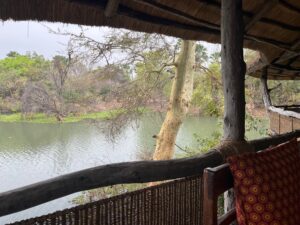
The view from the Upper Lodge at Mvuu, in Liwonde National Park, Malawi.
I’m sitting in a wicker chair and looking out over the Shire River from the comfort of what is essentially a glorified tree house. It’s been drizzling off and on since my son Caleb and I arrived two days ago. Staff at the lodge here in Liwonde National Park have joked that we brought the rain with us; the wet season in Malawi usually starts over a month from now.
Caleb invited me on this trip, created the itinerary, and paid for everything. I have no responsibilities other than to be a good traveling companion. To that end, I left my computer at home, as naked as that makes me feel, and am equipped only with a powerful set of binoculars and the notebook in which I’m writing these observations. It’s enough. If I record as many sensations and impressions as I can, in the moment, I won’t forget them by the time I return home.
A small yellow bird alights in the nearest tree and I snap to attention: Caleb and I have catalogued all of the birds we’ve seen since we arrived. So far, we’ve added about seventy new species to our life lists with the help of our formidable guide, David.
The lowing of a hippo from across the water distracts me and when I look back, the yellow bird has gone. I hadn’t meant to look — after all, this lodge is called Mvuu, which means “hippo,” because there are so many of them around — but I haven’t been here long enough to feel blasé about hippos, not yet.
No matter, I tell myself. I know the importance of details and I remember enough of them. The bird was about the size of a canary, with a white breast and wings that showed a bright yellow underside when it flew. I turn to my trusty Merlin Bird ID app, punch in the identifying information, and fail to find a perfect match. Was it some kind of weaver? Several species live around here. Or an Eastern Nicator? No, the coloring on this bird is too bright. A Cabanis’s Bunting? No, the breast was white, not yellow.
The nearest I can come is the Village Weaver, but I’m not satisfied. I wish I’d taken note of the shape of its beak and the color of its eyes before I looked away. Some of the birds I’ve seen here have been easy to identify – the Böhm’s Bee-eater, the Lilac-breasted Roller, the Malachite Kingfisher – because they have distinctive colors and shapes. This one, not so much; dozens of birds are similar. Here’s looking at you, convergent evolution.
I pull out the big guns: a 500-page hardback tome called Birds of Southern Africa (Expanded Edition). I turn to the weavers and find several possible candidates based on size and colors. I narrow it down, possibly, to a Spot-backed Weaver. I still have to confirm if they have yellow underwings, so I turn to Google.
Score. Google tells me that the Village Weaver is also known as […]
Read More
Some writers have it in mind from the beginning, for others it might be last-minute addition, prompted by a publisher’s question or a sudden impulse. To dedicate or not to dedicate—that is the question.
Dedications in books are certainly very common. Of the seven books on my bedside TBR pile, for example, just two lack a dedication. One of these features an epigraph instead, a line from a poem which expresses something at the heart of the book, and the other has no dedication at all. The dedications in the other five books are all personal, addressed to important people in the author’s life, which are in fact the most common kinds of dedications. Occasionally, though, you might see a more general type of dedication, in the vein of ‘to all those who have been there’. And it’s not just a modern thing—dedications in books have been common for hundreds of years. They started as statements of gratitude to patrons—for example, Shakespeare’s famous, enigmatic dedication for the Sonnets (though some say it wasn’t Shakespeare but the publisher who wrote the dedication). Or even further back, 12th century French writer Chrétien de Troyes’ dedication of his extraordinary seminal work, Le chevalier de la charrette (the Knight of the Cart), which simultaneously launched the character of Lancelot, a massive craze for Arthurian romance, and, for a francophone like me, the birth of the novel (‘roman’ being ‘novel; in French). Chrétien dedicated the work to his patron, Marie de Champagne, daughter of Eleanor of Aquitaine, writing it as a graceful, sprightly poem which cleverly manages to avoid outright flattery, and a light touch that combines humor and gratitude. (If you read French, you can see it here.)
But from at least the 19th century, book dedications tended to be more personal. Looking up some famous book dedications as I was preparing to write this post, I found some that were basically mini-letters to family members or friends, such as CS Lewis’ affectionate message to his god-daughter Lucy in The Lion, the Witch and the Wardrobe, and John Steinbeck’s touching letter, for East of Eden, to a friend who was also his editor. Others, like PG Wodehouse’s rather acidly humorous dedication to his daughter Leonora, were like a mini-version of the author’s characteristic style, or more surprising in their form, like Carl Sagan’s lovely, poetic tribute to his wife Annie. Although never as popular as personal dedications, general dedications also started to become more common in the 20th century and beyond. For example, Agatha Christie wrote a tongue-in-cheek dedication of The Secret Adversary to ‘all those who lead monotonous lives.’ She also wrote many personal dedications, and you can read a compilation here). Jack Kerouac wrote a pithily disillusioned dedication, ‘To America, whatever that is’, in his book, Visions of Cody. If you’re interested in reading about more famous book dedications and their backgrounds, this oldie-but-goodie article from the New York Times in 1982, is worth a look.
Okay, so I did go down the rabbit hole a bit with my […]
Read More
For today’s post I’m interviewing oral historian Alison Owings, whose latest book, Mayor of the Tenderloin, about San Francisco homeless advocate Del Seymour, came out this past Tuesday, September 10th.
The book has garnered considerable pre-publication praise, such as:
“Mayor of the Tenderloin is a charming, sometimes heartbreaking, tender, and inspiring story, important and beautifully written.”
—Anne Lamott, author of Almost Everything
“Alison Owings is a master of oral history. She is a great storyteller, and in Mayor of the Tenderloin, she has a great story to tell.”
—Dan Rather, author of What Unites Us
And Kevin Fagan remarked in a San Francisco Chronicle review:
Del Seymour is one of the hardest-working advocates for homeless people in San Francisco … and is regularly consulted for his street wisdom.
That wisdom came the hard way. He used to be a homeless crack addict and pimp, jailed many times before he shook drugs 14 years ago and started his uplifting [Tenderloin] tour and Code Tenderloin jobs programs. But what most people don’t know is that before all of that, he was an Army medic in the Vietnam War, a Los Angeles Fire Department paramedic, owner of a construction company and an electrician.
That’s where this book fills in the gaps. And how. Author Alison Owings lays out the at-times astonishing journey that led Seymour from a hard-knocks childhood in the Chicago projects through an adulthood that had him sleeping in a cardboard box in Sacramento, doorways and dive hotels in San Francisco, making and spending money like water legitimately as a businessman in Los Angeles and illegitimately as a pimp here, and finally shaking dope cold turkey when he hit rock bottom in a fight over $10 to $20 worth of crack.
Alison began her writing career as a journalist and has traveled extensively around the world. Her travels specifically in Europe inspired her to write a satire, The Wander Woman’s Phrasebook / How to Meet or Avoid People in Three Romance Languages, and her highly praised first foray into oral history, Frauen: German Women Recall the Third Reich.
Frauen set the stage for her next three multi-year projects, Hey, Waitress! The USA from the Other Side of the Tray; Indian Voices: Listening to Native Americans; and now Mayor of the Tenderloin: Del Seymour’s Journey from Living on the Streets to Fighting Homelessness in San Francisco.
Their thematic commonality? An examination of stereotypes. The implied question: when you picture a German woman of the Third Reich, or an American waitress, or a Native American, or a homeless person, do you see them the same way after reading these books?
Hi, Alison, welcome to Writer Unboxed. You come from a journalism background, but you’ve focused specifically on oral histories in your last four books. What prompted your interest in that unique approach?
In a way it’s an adjunct to journalism—asking questions. It began inadvertently, too, when I realized that retired German women I met who were living in a village in southern Spain were witnesses to the Third Reich and had more or less been ignored. They became the basis of Frauen and set my preference of “interview virgins”—first timers. I’m not too interested in interviewing […]
Read More
My dad, Grant Overstake, has written millions of sentences. As a former journalist, pastor, and now novelist, he’s got what the writing world considers “chops.” Big papers like the Miami Herald published his sports column for years, and small papers had his by-line on every article from op-eds to sports to obits.
His young adult sports novels are precise, beautiful, engaging. His sermons, spoken word he wrote to help rural Kansans navigate their faith journeys and complicated lives in the late 90s, were captivating, heart-felt, well-rounded. This man has done it all in the writing world — if I listed his awards, I’d reach my word-limit in this article.
I decided early in my life that I, too, would be a writer. If you’re a parent and you try to get your kid to find passion in the things you love, you likely will feel one of two things: the sting of rejection accompanying an eye-roll, or the wave of pride accompanying an attempt. My first attempt was verbal storytelling, just like my dad behind the pulpit. It turned into written storytelling as soon as I could hold a pen. Sign me up, Dad! I wanted to be like him.
Sometimes, a sign-me-up attitude can be intimidating as a parent. What if your child is no good? What if they’re not coachable? What if criticism of them is too much? I don’t know what form of bravery swept me as a child, but I showed my award-winning journalist father my first attempt at a novel, written in a wide-ruled spiral-bound notebook.
“Don’t overwrite,” he said. “Simplify it. Here, read this.” And he handed me Hemingway, Herman Hesse, and Rick Reilly.
In high school, he read my articles for the school paper and with his bracing, left-handed scrawl, edited with no hesitation. I remember, at first, that it stung. I might’ve cried. I was fifteen, learning from a master. I worked harder, read more closely, listened carefully. I built my words on the true stories from a small-town high school where football reigned supreme. In this world, the girls on the sidelines weren’t writing articles; they were dressed in cheer uniforms, caught up in the spectacle rather than the storytelling.
I donned a cheer uniform, too, and learned and listened to how sports were played. I wrote for myself, for my classes, for my newspaper, for essay contests. I sought my dad’s praise, his admiration, his subtle nod that affirmed I’d done it right. I won some of my own awards.
I had to learn, from an amazing writer, how to accept what a first draft is: each sentence might change. Bones are there, meat needs to fill in around it. Simpler is better. Red ink is strengthening your work. None of this is personal – these words are not tattooed on you. Nothing is permanent until the paper’s put to bed, kid. I remember the smell of newsprint, the dusting of ink on the sides of his hands, his press badge on the kitchen counter, his fingers calloused with the grip of a pencil.
I learned how to accept his red ink […]
Read More
Once upon a time, there was a contest that asked people to write a novel in three days.
(The Three-Day Novel Contest still exists, actually – I looked it up, and it takes place annually over Labor Day weekend! A little late to get started for this year.)
National Novel Writing Month (NaNoWriMo) is one thing—generating a complete first draft in one month, as thousands of people attempt every November—but the three-day novel (https://www.3daynovel.com) is a whole different ball of wax.
To generate a 50K-word first draft in a month, your pace is 1667 words per day.
To do the same in three days instead of thirty? 16,667 words.
(Assuming you write 20 hours of each day for three days, which would be insane but also maximize your writing time, that’s 833 words per hour. Writing 17 hours a day leaves more time for sleep, but ups your hourly count to 980 words each hour. Good luck, y’all!)
The fast first draft isn’t for everyone, and the three-day novel definitely isn’t. But as a writer who loves to pour on the speed when circumstances allow, and someone who produces an insanely messy first draft even when I take my time and write slowly, I find that setting a blistering pace is absolutely the best way for me to get a big chunk of that first draft on the page.
If you want to give it a shot, here are my three favorite guidelines for putting the most words on the page as quickly as possible.
(Three-day novel not guaranteed.)
Set goals, but don’t obsess. Yes, you’re trying to get to a certain number on a certain schedule. Yes, it will probably help you focus if you chunk up the goal into smaller pieces (10K before dinner on Day 1, 35K before bed on Day 2, etc.) But getting obsessed with hitting those goals precisely will mess with your head and your productivity. And if you set out to write 50K words in three days and you only get to 30K? That’s still 30K words you didn’t have before! Congratulations.
Generate without judgment, but don’t cheat. There are ways to crank up your word count without generating text that has a chance of making it into the finished novel. When I officially entered the Three-Day Novel Contest back in the early 2000s, I definitely did things I knew didn’t make sense for a finished novel. I included song lyrics. Encyclopedia entries. I had my protagonist, a college professor, walk across his campus and think about every building he saw. These are not things that make for riveting reading. In a second draft, they would come out anyway. Try to minimize them in your first draft, even when you’re going for speed. (But if you type something and later think, I shouldn’t have included that, do NOT go back and delete. We are not deleting here. That’s not how this works.)
Start early, but don’t start from scratch. There is a very specific moment in a novel’s development when I can write a thousand words in an hour […]
Read More
Therese here to introduce you to someone near and dear to me: my son, Liam. ❤️
Liam’s screenwriting journey started as a Rod Serling fan. Inspired by Serling’s allegorical storytelling, he attended USC’s film school where his thesis film, You Missed a Spot, was selected in over 30 festivals internationally. Since then, he has worked on the production-side of the industry, most recently wrapping as the line producer’s assistant on FX’s Mayans MC.
You may have heard about the downturn of work in Hollywood, and so Liam has bided his time between jobs doing something he was likely, inevitably, genetically born to do: WRITE. That the short story he’s written, that he’s now determined to see produced (see Kickstarter), taps into a real-life wound should come as no surprise to you, WU community.
But I’ll let Liam tell you about that, WU-style. Take it away, kiddo.
As writers, we often face the challenge of crafting stories that feel authentic, especially when venturing into experiences we haven’t lived ourselves. This was the case for me when I set out to write my new short film, Venus in Furs, a psychological thriller that personifies heroin as a woman.
I’m a filmmaker living in Los Angeles, and my life was deeply impacted when one of my close friends from film school overdosed on drugs laced with the powerful synthetic opioid, fentanyl. I remember the first time I met him—we were attending a mandatory lecture on the cinema and music of the 1960s. We were sitting on either side of another student we both had a crush on and got into a pointless debate about The Doors, as if this poor girl remotely cared about some band from five decades ago. He demolished me in the debate. The guy was like Jim Morrison himself—long-haired, charismatic as hell, with a ribcage you could practically see through his t-shirt.
After the girl successfully escaped, the two of us grabbed lunch and admitted we were only trying to impress her. Instant friendship.
During lunch, our conversation abruptly ended when he mentioned he was going to leave to smoke some opium. I assumed he was joking at the time—I mean, I had just met the guy. What, opium? You mean that shit from the 1800s? But over time, I came to learn that he was affected by a powerful addiction that, to him, wasn’t some unshakable affliction as often depicted, but rather the means to radically take hold of his post-high-school freedom and live out the fantasy of the rock ’n’ roll lifestyle he so loved.
The last time I saw him, I visited his three-bedroom high-rise in Downtown Los Angeles, full of vintage records and a collection of Les Pauls paid for with credit cards he couldn’t pay off. It was the Fourth of July, and he was excited to launch fireworks at passing cars. At that point, I had witnessed the drug obliterate his ambitions. He had stopped attending classes, gained weight, and lost that magic spark that drew me to him in the first place. Heroin took everything from him. And yet he was so happy to participate in his own self destruction. In fact, sitting there with all his guitars and […]
Read More
I love the Olympics. Summer and Winter. The athletes from all over the world, The sports most of us only see every four years. The glorious variety of the human body and what it can do. Let me see it all!
The television coverage is mostly about winners and the medal count: who won, who was supposed to win but didn’t, how much they won by, or how little, how much or how little they lost by, who and which country has the most medals, most golds.
But the more race- and event-side interviews I heard, the more I saw that the athletes focused on other things: their game plan, their training, their mental and physical fitness, their support system. For some, executing their game plan would result in a medal. For the majority of competitors, it would not.
Yet they were all Olympians.
And Olympians seem to measure success differently from the shiny-reward-obsessed media and public.
Chris Chavez asked Connor Mantz, a U.S. marathoner who came in 8th at the Olympics how he evaluated success for the race. Mantz said,
“The build for it was really, really good. I think my fitness was great. I think I was in a great spot, physically. The more I review it, I probably underperformed for how fit I was, but it’s hard to evaluate…. I was going in with the mentality that I could medal even before we left. I just knew my fitness was at a different level. Yes, eighth is great and I’m happy about that, but I don’t think my fitness really showed in this marathon. I think I have another level that I’m trying to bridge the gap to.”
If you listen to the entire hour-long interview, you can see how granular Mantz gets, all the different ways he considers his performance, which was a 2-hour result of years of work and training. He’s happy with the result, even as he sees room for growth and improvement.
American sprinter Noah Lyles talked with great confidence (some called him cocky) at the beginning of the Games. Commentators gushed at the possibility that he could win gold in the men’s 100m and 200m. He won gold in the 100. But in the 200, a race he expected and was expected to win, he got bronze and had to leave the track on a wheelchair because he was physically struggling to breath and walk after running that race with COVID. Shortly after, he gave a trackside interview to Lewis Johnson:
“It’s taken its toll for sure, but I’ve never been more proud of myself for being able to […]
Read More
Recently, I parted ways with my agent and although I know it was the right decision, it’s still gut-wrenching.
Soon after, I sent out a couple of queries and had a request for the full of my latest manuscript. That agent asked for an exclusive look for two weeks. I agreed and withdrew my other queries. The exclusive teased out to a month. She said no.
Fair enough. This is not my first rodeo.
The next day, I sent the full to another agent who had asked to see it, if it was available after the exclusive ran out. After saving the draft I sent to her, I made a new Scrivener document called “Draft Seven”, intending to incorporate the first rejecting agent’s critical input, which I was grateful to receive. I intended to revise, then send out more queries.
When I began, that morning, to rework the opening of my novel, I fumbled. I tripped, started again, stopped, then consumed a full bag of M&M’s (the ‘sharing’ size). Like a floodgate opening, self-doubt rushed in and I felt like I was bobbing around some pretty rank water, trying not to panic and to remember how to float. I doubted I could fix what was wrong and wasn’t even sure what to change. Every shred of negative feedback I’ve ever received on anything I ever wrote came raining down. Should I switch from first person POV to close third? Should I Save the Cat?
After a few more days and a ‘no’ from the second agent, I decided I needed time to stew, contemplate, and process. To float for a bit. Because, yes, those feelings of rejection and failure I was pushing away were absolutely real.
Then I thought, why just step back? Why not walk away?
Please don’t write me off (no pun intended) as a slacker who can’t take criticism. I have and I can. This was a crossroads moment. My third novel has been under construction for three years, and it hasn’t come easily. Soon, I’ll turn sixty-five. Instead of writing, I could use my time to make dollhouses and to garden. Maybe I could become a more interactive grandmother. Maybe I’d order a Jitterbug flip phone and take up Prancercizing!
Afloat in the balmy sea of denial, I decided I’d try Not Being A Writer (henceforward, NBAW) for a few weeks and see how it felt.
My first week of NBAW involved some tidying up of loose ends, beginning on Sunday with a book club talk that had been on my calendar for months. The group had read my second novel, In All Good Faith, which was published in August 2021. I gave the 25-minute PowerPoint slideshow I usually give, with lots of vintage photographs from the Great Depression. After my talk, there was chitchat, with cheese cubes. As always, interacting with readers was gratifying. Someone asked when my next book would come out and I gave my pat answer: I’m revising. I didn’t know how to say that I was no longer writing.
On Monday, I read an ARC of a debut novel by a friend from my MFA program. I’d agreed to write a blurb. I remembered the agony of asking authors for blurbs and the […]
Read More
In her July 11 post (Dear Protagonist: You Want This Job or What?), Kathryn Craft laid out a scenario as a set-up for a story, and in his comment, Donald Maass said this:
In your fragment, you have set up both Hannah and MacGregor as grieving the same thing but also at odds with each other. One needs a loving memory of Keith, the other needs to remove a memory of Keith that stirs up the unbearable pain of his loss. For both, that is the same thing: the maple tree.
Nicely done. To me, that is a great beginning. It’s a situation but not yet a story. Now, what I expect is that Hannah and MacGregor will find their common ground.
That dichotomy, situation-versus story, stuck in my mind. I thought about James Joyce’s Dubliners, in which each story is about paralysis—specifically, the various types of moral, psychological, sociological, and sexual stagnation suffered by the Irish at the hands of their two great nemeses: the British Empire and the Roman Catholic Church.
Although the characters do indeed take actions of various sorts, they inevitably lead to naught—because of their inability to make their actions matter due to the inner constraints they’ve accepted, consciously or unconsciously.
I thought as well of one of my favorite short stories by Kafka, “An Imperial Message.”
The Emperor, so the parable runs, has sent a message to you, the humble subject, the insignificant shadow cowering in the remotest distance before the imperial sun; the Emperor from his deathbed has sent a message to you alone.
However, due to the vast crowds that have come to the capital with news of the Emperor’s imminent demise, the messenger to whom the ruler gives this duty is unable to even make way beyond the chambers of the innermost palace.
If he could reach the open fields how fast he would fly, and soon doubtless you would hear the welcome hammering of his fists on your door. But instead how vainly does he wear out his strength… [encountering] more stairs and courts; and once more another palace; and so on for thousands of years; and if at last he should burst through the outermost gate—but never, never can that happen—the imperial capital would lie before him, the center of the world, crammed to bursting with its own sediment. Nobody could fight his way through here even with a message from a dead man. But you sit at your window when evening falls and dream it to yourself.
Admittedly, a parable is a specific type of story, but a great many of Kafka’s shorter works—such as “A Visit to a Mine” or “Eleven Sons”—possess this same quality.
But this approach didn’t die with Modernism. I recently devoured the story collection The End of the World is a Cul de Sac, by the Irish writer Louise Kennedy. (Seriously, I cannot recommend it more highly.) Many of her stories fall into this same category: depicting an admittedly elaborate, intimately detailed, and trenchantly observed situation rather than a “story” leading to a resolution of an underlying conflict, an “epiphany,” or some other transformative insight on the part of the characters.
Rather, through the creation of expectation by the careful sequencing of details—and […]
Read More
photo adapted / Horia Varlan
With a plot that is literally moving from one place to another, a story structure that relies on a geographical tour seems ready made for story movement. But can such a tour cough up enough emotional import to serve as the beating heart of a novel? It can—but there’s nothing automatic about it, as mixed results from two recent, highly-anticipated releases will show.
One of them worked. The other, not so much.
*Before I continue, a note: The intent of this post is to analyze story in a way that might aid our own writing efforts, not to initiate a guessing game. Thanks in advance for honoring this intent in the comments. To protect the authors, I have altered details about their novels.
In Book 1, the protagonist is conducting a grand tour of multiple countries to teach two struggling friends lessons about love. An upcoming event provides a ticking clock. While this goal is met with mixed results, her efforts end up changing her more. No reason that shouldn’t work.
The plot in Book 2 centers around a more localized tour. When the protagonist intends to move away from her new town due to the failed romance that brought her there, a major secondary character is determined to show the protagonist the lesser-known reasons she could still learn to love the area. The protagonist’s determination to leave after the culmination of a major work project provides a ticking clock. This also should work.
Yet all things considered, Book 2 generated more effective story movement. Let’s look at why, through the lens of four questions you can ask yourself about your own plot.
1. Is the movement in the story?
As we discuss often here at Writer Unboxed, plot and story are not the same thing. In short, plot is an external layer of story comprised of the action the protagonist takes toward achieving their story goal and the obstacles that will foil their efforts. A story, on the other hand, explores the way this external plot forces the protagonist to face consequences (stakes) they’d hoped to avoid, resulting in pressures that will slowly but surely move the protagonist along an arc of inner change.
This interweaving of external pressure and inner change creates story movement. Even plot events that include explosive fighting and sexual tension—or both at once!—can stagnate a story if they have no effect on the protagonist.
For the most part, when we humans rise to a challenge and face something hard, we grow—and it’s up to you as author to show your reader how this inner change will be relevant to your protagonist’s particular needs. Why “needs”? Because your protagonist will need to lean on these enhanced skills to prevail during the story’s climactic fight.
By design, the novels I’m comparing for this post both contain plot movement, since their scenes move from locale to locale. But in Book 1, the protagonist is so focused on changing others that she never seems to see the unaddressed problem in her own life, leaving her frustrated by the same things throughout the story. This reiteration results in zero-sum story movement.
Read More

Me, walking into a cocktail party at a writer’s conference: I am confident in my writing ability. I have worked hard to improve my craft. I have insights and wisdom worthy of sharing. I deserve my seat at the publishing table.
Also me, walking into the same room: When is everyone going to figure out I’m a hack? I don’t deserve to be in this room.
Which one are you? Do you walk into a room full of writers and feel like you deserve to take up space in the publishing world? Or do fear being unmasked as an imposter?
Or maybe, like me, you do both.
Ever since I walked into my first writing workshop, I’ve been dangling from a pendulum that swings wildly between postures of confidence and crippling imposter syndrome. I believe it’s healthy to temper confidence with a bit of self-doubt, and I believe toxic self-doubt can be righted by remembering your true, honest accomplishments, even if they are small. I have trouble navigating the space between the two.
I’m still trying to figure out how to balance the confident fake-it-til-you-make-it mindset and imposter syndrome, but I’ve learned a few strategies that help me navigate the highs and lows.
Last month I turned in my third novel, The Forest Becomes Her, slated for publication in early 2026 from St. Martin’s Press. I’m already hard at work on my fourth novel, which is also under contract. Six years ago, I would have been giddy to know I would publish a novel. If someone had told me there would be four (and hopefully more) I would have passed out from joy.
But I also would have been skeptical. Why would anyone publish my novels? I’m a hack, I would have thought.
When I started working on my first novel manuscript, I embraced the fake-it-til-you-make-it approach to the publishing world. I believed in my book, but I didn’t have any relevant experience to include in a query letter. I looked at my unimpressive resume, and, instead of giving up, I decided to fill out my CV, one line at a time.
As I continued working on my novel manuscript, I entered contests. Flash fiction, short stories, novel excerpts. So many contests. Most of them led to disappointment, but I won several. I entered the wins into my scant author bio. Award-winning writer.
I submitted widely to literary journals, and, along with a pile of rejections, I received a few scattered acceptances, although, admittedly, they were all from smaller journals. I added these publishing credits to my bio. Published fiction writer.
I contributed essays to numerous websites that accept guest posts and wrote book reviews for a few websites. I was a blogger and book reviewer.
I volunteered to lead some small writing workshops. I was a workshop leader.
None of these minor successes involved platforms like Pulitzer or Ploughshares or The New York Times, but they were legitimate, hard-fought wins, and I was proud of them. I was making small inroads.
After a few years, the bio paragraph in my query letter began to feel respectable. I, however, wasn’t impressed. None of the lines in my bio were false. They weren’t exaggerations. I had won several writing contests, published a handful of essays, reviewed books, published short stories, and taught writing classes. […]
Read More